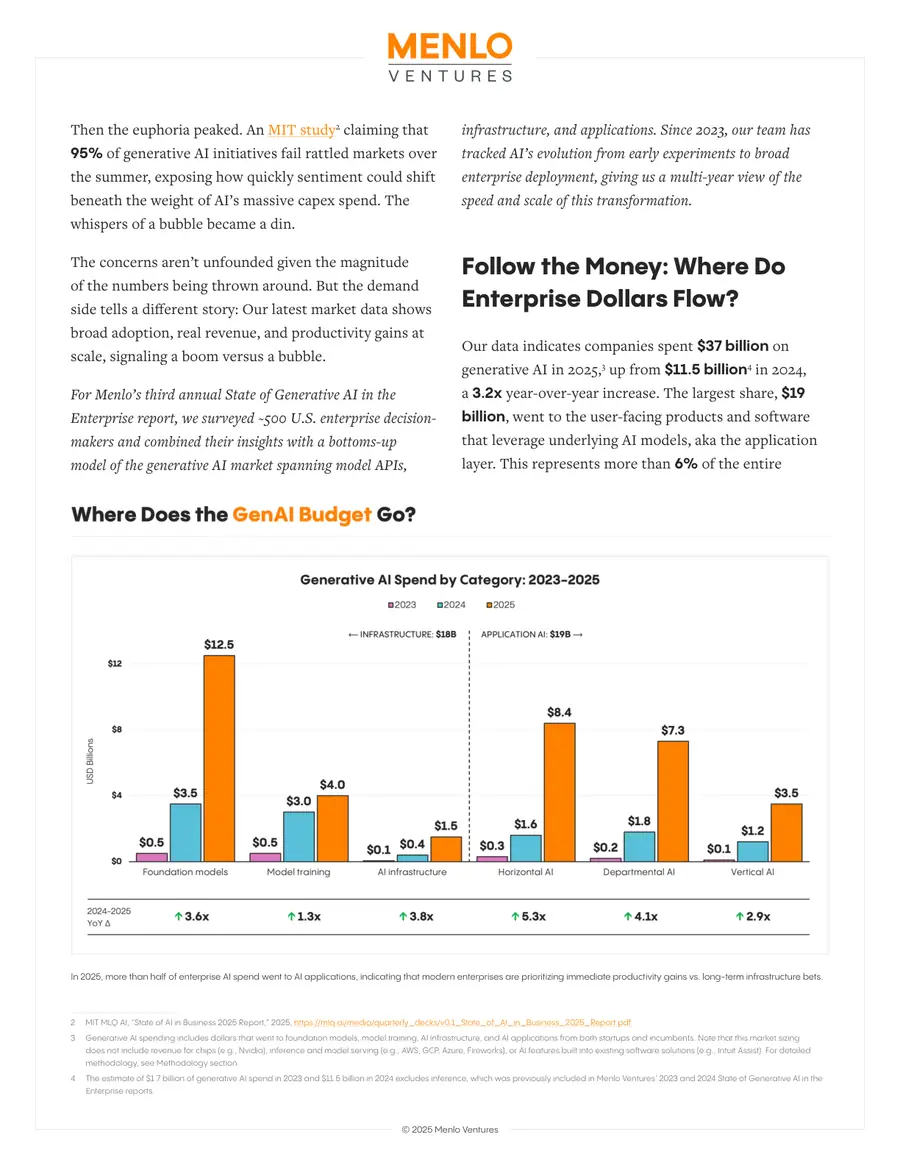
software market, all achieved within three years of ChatGPT’s launch. Growth extends far beyond a handful of AI chat apps, touching every domain in the economy. By our count, there are now at least 10 products generating over $1 billion in ARR and 50 products generating over $100 million in ARR, led by the model APIs powering applications (Anthropic*, OpenAI, Google), but increasingly distributed across departmental solutions in coding, sales, customer support, HR, and verticals from healthcare and legal to the creator economy.
The Path to Production
After three years, enterprise AI’s path to production has taken shape. Early adopters had no playbook. Now, distinct patterns have emerged that break from
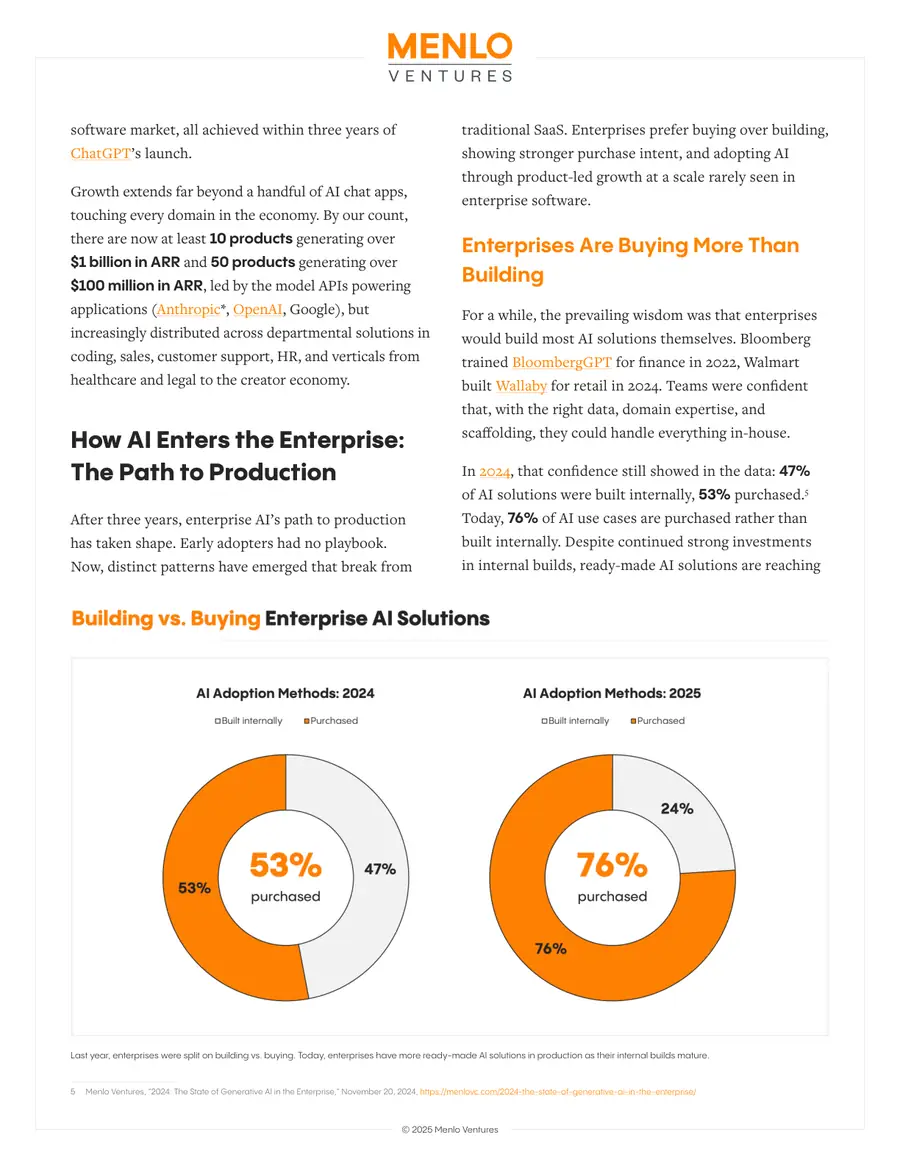
Last year, enterprises were split on building vs. buying. Today, enterprises have more ready-made AI solutions in production as their internal builds mature.
- Menlo Ventures, “2024: The State of Generative AI in the Enterprise,” November 20, 2024, https://menlovc.com/2024-the-state-of-generative-ai-in-the-enterprise/
traditional SaaS. Enterprises prefer buying over building, showing stronger purchase intent, and adopting AI through product-led growth at a scale rarely seen in enterprise software.
Enterprises Are Buying More Than Building
For a while, the prevailing wisdom was that enterprises would build most AI solutions themselves. Bloomberg trained BloombergGPT for finance in 2022, Walmart built Wallaby for retail in 2024. Teams were confident that, with the right data, domain expertise, and scaffolding, they could handle everything in-house. In 2024, that confidence still showed in the data: 47% of AI solutions were built internally, 53% purchased.5 Today, 76% of AI use cases are purchased rather than built internally. Despite continued strong investments in internal builds, ready-made AI solutions are reaching