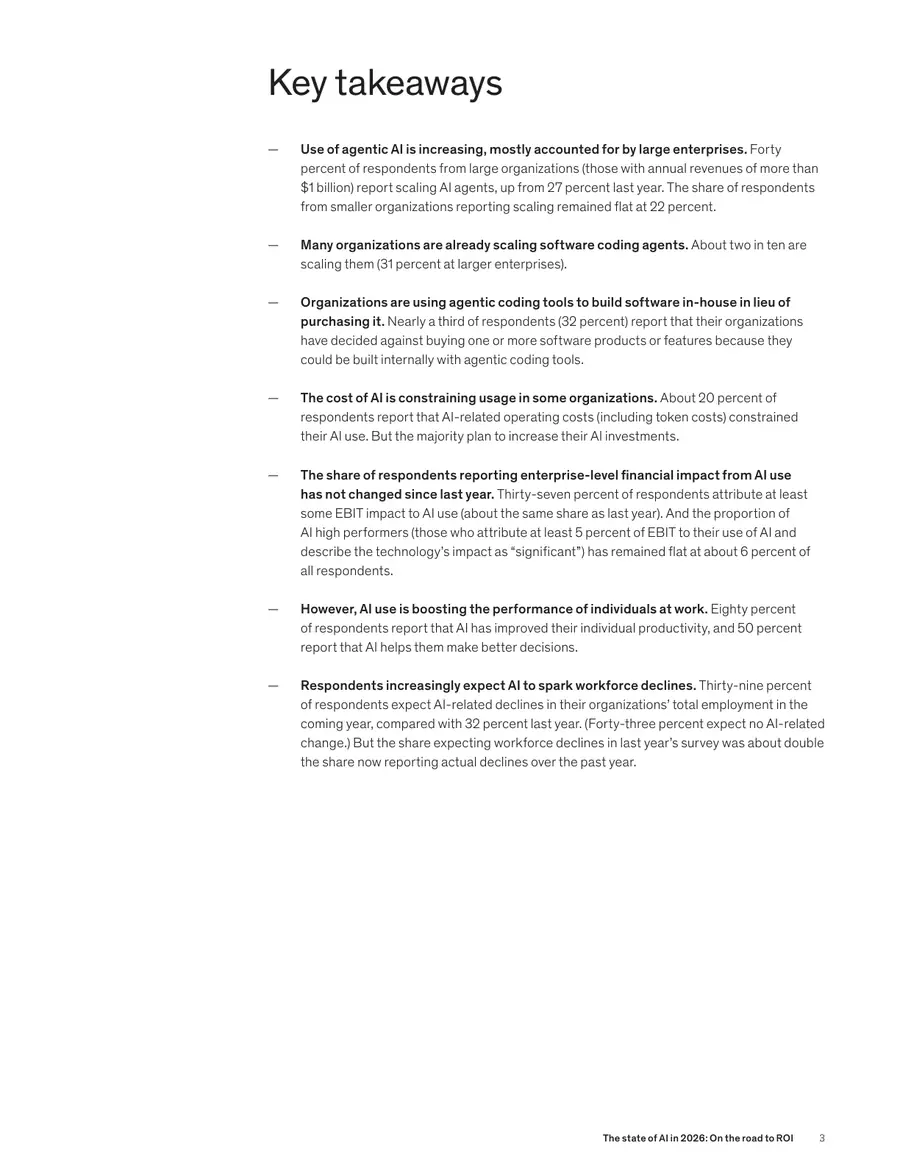
Use of agentic AI is increasing, mostly accounted for by large enterprises. Forty percent of respondents from large organizations (those with annual revenues of more than $1 billion) report scaling AI agents, up from 27 percent last year. The share of respondents from smaller organizations reporting scaling remained flat at 22 percent. Many organizations are already scaling software coding agents. About two in ten are scaling them (31 percent at larger enterprises). Organizations are using agentic coding tools to build software in-house in lieu of purchasing it. Nearly a third of respondents (32 percent) report that their organizations have decided against buying one or more software products or features because they could be built internally with agentic coding tools. The cost of AI is constraining usage in some organizations. About 20 percent of respondents report that AI-related operating costs (including token costs) constrained their AI use. But the majority plan to increase their AI investments. The share of respondents reporting enterprise-level financial impact from AI use has not changed since last year. Thirty-seven percent of respondents attribute at least some EBIT impact to AI use (about the same share as last year). And the proportion of AI high performers (those who attribute at least 5 percent of EBIT to their use of AI and describe the technology’s impact as “significant”) has remained flat at about 6 percent of all respondents. However, AI use is boosting the performance of individuals at work. Eighty percent of respondents report that AI has improved their individual productivity, and 50 percent report that AI helps them make better decisions. Respondents increasingly expect AI to spark workforce declines. Thirty-nine percent of respondents expect AI-related declines in their organizations’ total employment in the coming year, compared with 32 percent last year. (Forty-three percent expect no AI-related change.) But the share expecting workforce declines in last year’s survey was about double the share now reporting actual declines over the past year.
The state of AI in 2026: On the road to ROI