AI 研究报告图文讲义4594 字

Menlo Ventures|State of Enterprise AI 2026

·全库 692 / 711

《Menlo Ventures|State of Enterprise AI 2026》共 21 页、0.5 万字,通篇围绕 Agent、embedding 展开,归在「AI 研究报告」这一层。

覆盖Agentembedding

适合要拿第三方研究报告做对标、判断自己 AI 转型走到哪一步的人

目录骨架(8 节)
  1. 2026: The State
  2. Part I. The Agent Inflection
  3. Part II. Model Usage
  4. Final Thoughts
  5. of Enterprise AI
  6. Key Findings
  7. Enterprise AI Reaches Scale
  8. VENTURES

原 PDF 已逐页还原成图,共 21 页;左侧目录可直接跳页。右侧文字取自原件文字层, 以图为准;点图可全屏放大。

本讲义目录 · 3 页
  1. 012026: The State
  2. 02The speed of AI’s rise set off alarms.
  3. 03Part I. The Agent Inflection
011 / 3
第 1 页:2026: The State
第 1 页

2026: The State

of Enterprise AI

November 3, 2026

Key Findings

  • Enterprise AI deployment spend scaled to $177B by September 2026, up from $33B last year. Growth is accelerating:

5.4x vs.

3.9x a year ago. Every dollar that went into developing models this year is generating $1.70 of revenue.

  • Agents changed the math: OpenRouter agent traffic is up 37x since overtaking human traffic in February, tying spend to work performed rather than users.
  • For now, money follows capability: Frontier labs command 69% of deployment dollars (vs. 50% last year). Anthropic’s share of enterprise API spend increased from 40% to 55%, OpenAI’s from 27% to 31%, while Google’s fell from 21% to 9%. Open-source remains 4% of spend despite 19% of usage.
  • AI spend concentrates where agents work best: Coding ($34.0B) and chatbots ($25.0B) make up 76% of the $77.3B app market because they offer environments in which agents can act, workflows they can learn, and results they can verify.
  • AI-natives are winning new agent categories like coding, which is 96% AI-native. Compared to last year, incumbents are gaining share in IT (91%), data science (88%), and HR (68%).
  • AI is expanding the software economy: 55% of AI dollars is from net new spend, rather than existing software or labor budgets.

Enterprise AI Reaches Scale

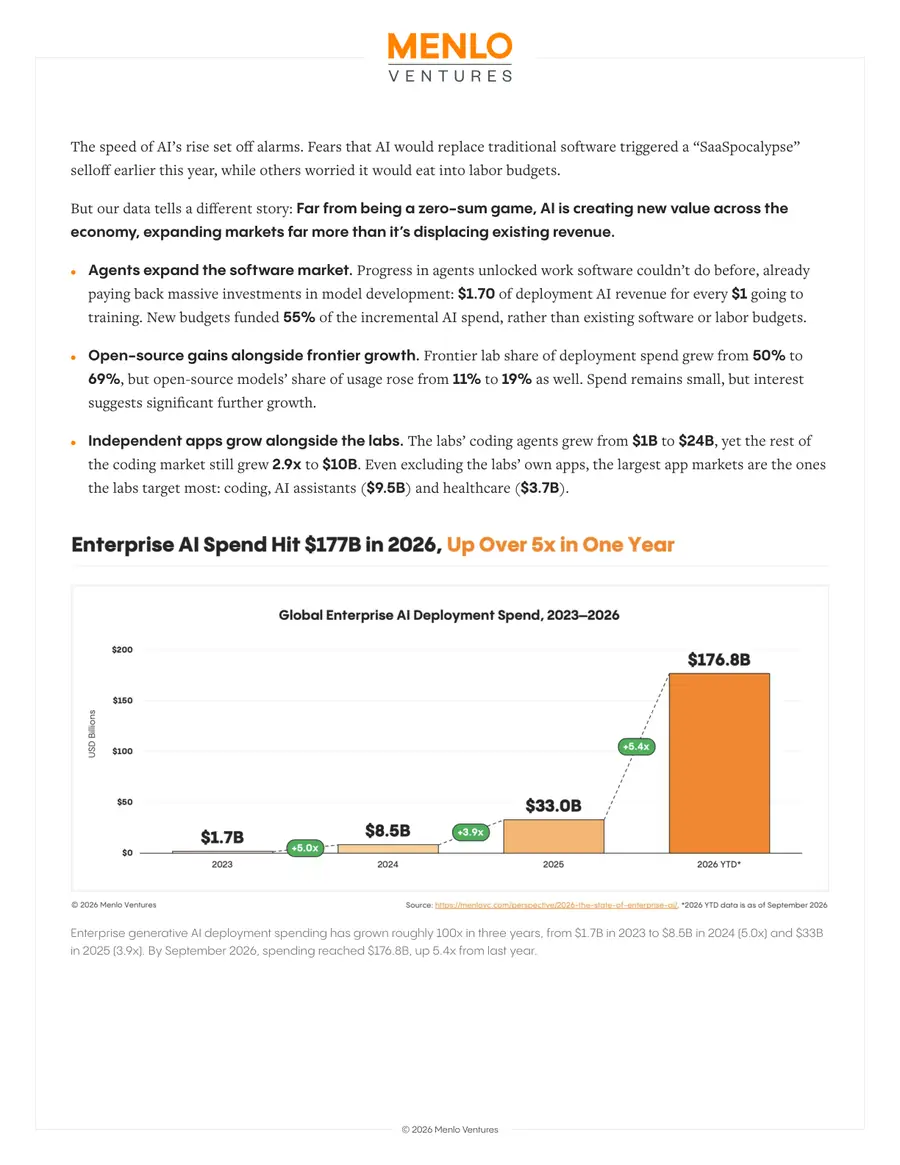
In 2026, AI became an economy-scale force. Enterprise AI deployment spending surged from $33 billion to $177 billion in just one year. That’s over $140 billion in new annual spending, almost four times the size of the entire market a year ago.

Tim Tully, Joff Redfern, Deedy Das, and Derek Xiao

022 / 3
第 2 页
第 2 页

The speed of AI’s rise set off alarms.

  • The speed of AI’s rise set off alarms. Fears that AI would replace traditional software triggered a “SaaSpocalypse” selloff earlier this year, while others worried it would eat into labor budgets. But our data tells a different story: Far from being a zero-sum game, AI is creating new value across the economy, expanding markets far more than it’s displacing existing revenue.
  • Agents expand the software market. Progress in agents unlocked work software couldn’t do before, already paying back massive investments in model development: $1.70 of deployment AI revenue for every $1 going to training. New budgets funded 55% of the incremental AI spend, rather than existing software or labor budgets.
  • Open-source gains alongside frontier growth. Frontier lab share of deployment spend grew from 50% to 69%, but open-source models’ share of usage rose from 11% to 19% as well. Spend remains small, but interest suggests significant further growth.
  • Independent apps grow alongside the labs. The labs’ coding agents grew from $1B to $24B, yet the rest of the coding market still grew

2.9x to $10B. Even excluding the labs’ own apps, the largest app markets are the ones the labs target most: coding, AI assistants ($9.5B) and healthcare ($3.7B).

Enterprise generative AI deployment spending has grown roughly 100x in three years, from $1.7B in 2023 to $8.5B in 2024 (5.0x) and $33B in 2025 (3.9x). By September 2026, spending reached $176.8B, up

5.4x from last year.

033 / 3
第 3 页:Part I. The Agent Inflection
第 3 页

Part I. The Agent Inflection

Agents Have Grown to 80% Of AI Usage

The biggest story of the past year has been the rise of AI agents. The launch of Anthropic’s* Opus

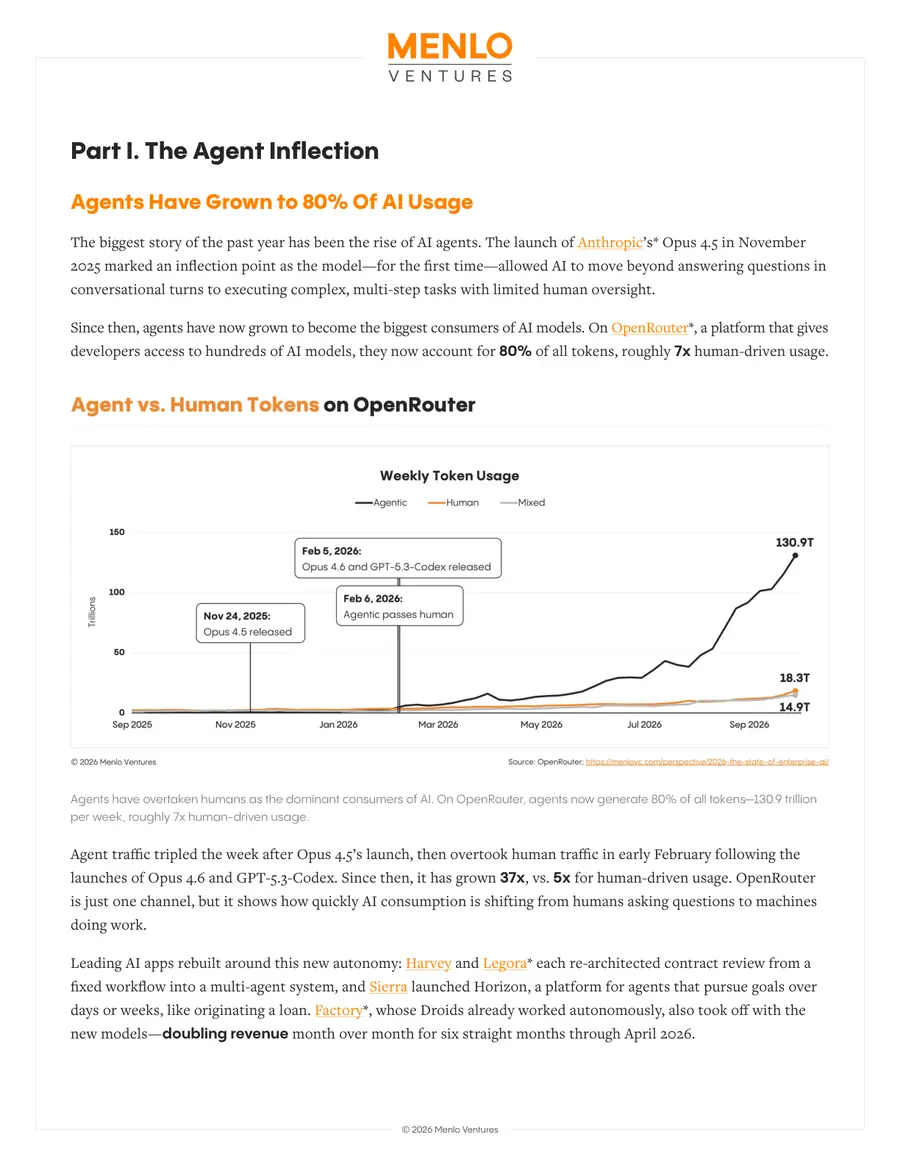
4.5 in November 2025 marked an inflection point as the model—for the first time—allowed AI to move beyond answering questions in conversational turns to executing complex, multi-step tasks with limited human oversight. Since then, agents have now grown to become the biggest consumers of AI models. On OpenRouter*, a platform that gives developers access to hundreds of AI models, they now account for 80% of all tokens, roughly 7x human-driven usage.

Agents have overtaken humans as the dominant consumers of AI. On OpenRouter, agents now generate 80% of all tokens—130.9 trillion per week, roughly 7x human-driven usage.

Agent traffic tripled the week after Opus 4.5’s launch, then overtook human traffic in early February following the launches of Opus

4.6 and GPT-5.3-Codex. Since then, it has grown 37x, vs. 5x for human-driven usage. OpenRouter is just one channel, but it shows how quickly AI consumption is shifting from humans asking questions to machines doing work. Leading AI apps rebuilt around this new autonomy: Harvey and Legora each re-architected contract review from a fixed workflow into a multi-agent system, and Sierra launched Horizon, a platform for agents that pursue goals over days or weeks, like originating a loan. Factory, whose Droids already worked autonomously, also took off with the new models—doubling revenue month over month for six straight months through April 2026.

资料里没有你的场景?

把你手上的数据和想解决的那个环节发上来,我们按具体情况回,不复述方法论。

发布需求