
Gartner|Hype Cycle for Generative AI 2025(文字版)
《Gartner|Hype Cycle for Generative AI 2025(文字版)》共 118 页、2.9 万字,通篇围绕 RAG、Agent、prompt、embedding 展开,归在「AI 研究报告」这一层。
适合要拿第三方研究报告做对标、判断自己 AI 转型走到哪一步的人
原 PDF 已逐页还原成图,共 118 页;左侧目录可直接跳页。右侧文字取自原件文字层, 以图为准;点图可全屏放大。
本讲义目录 · 3 页

Hype Cycle for Generative AI, 2025…
Hype Cycle for Generative AI, 2025 | Gartner G00832685 | p.1 of 118
Gartner, Inc. | G00832685Page 1 of 113 Hype Cycle for Generative AI, 2025 14 July 2025- ID G00832685- 127 min read By: Arun Chandrasekaran, Leinar Ramos Initiatives: Artificial Intelligence; Define the Future-State Architecture for the Enterprise; Deliver IT and Business Value Through Enterprise Architecture; Architect, Implement and Scale Data and Analytics Solutions; Generative AI Resource Center; Integrate Technology to Achieve Business Outcomes Generative AI technologies and techniques are evolving at an unprecedented pace, matched only by the surrounding hype, which makes it challenging for leaders to navigate this dynamic landscape. AI leaders can leverage this Hype Cycle to identify the innovations most worth pursuing as they shape and execute their AI strategies. Strategic Planning Assumption By 2028, over 95% of enterprises will have used generative AI (GenAI) APIs or models, and/or deployed GenAI-enabled applications in production environments. This research note is restricted to the personal use of jalvarez@oracle.com.
Hype Cycle for Generative AI, 2025…
Hype Cycle for Generative AI, 2025 | Gartner G00832685 | p.2 of 118
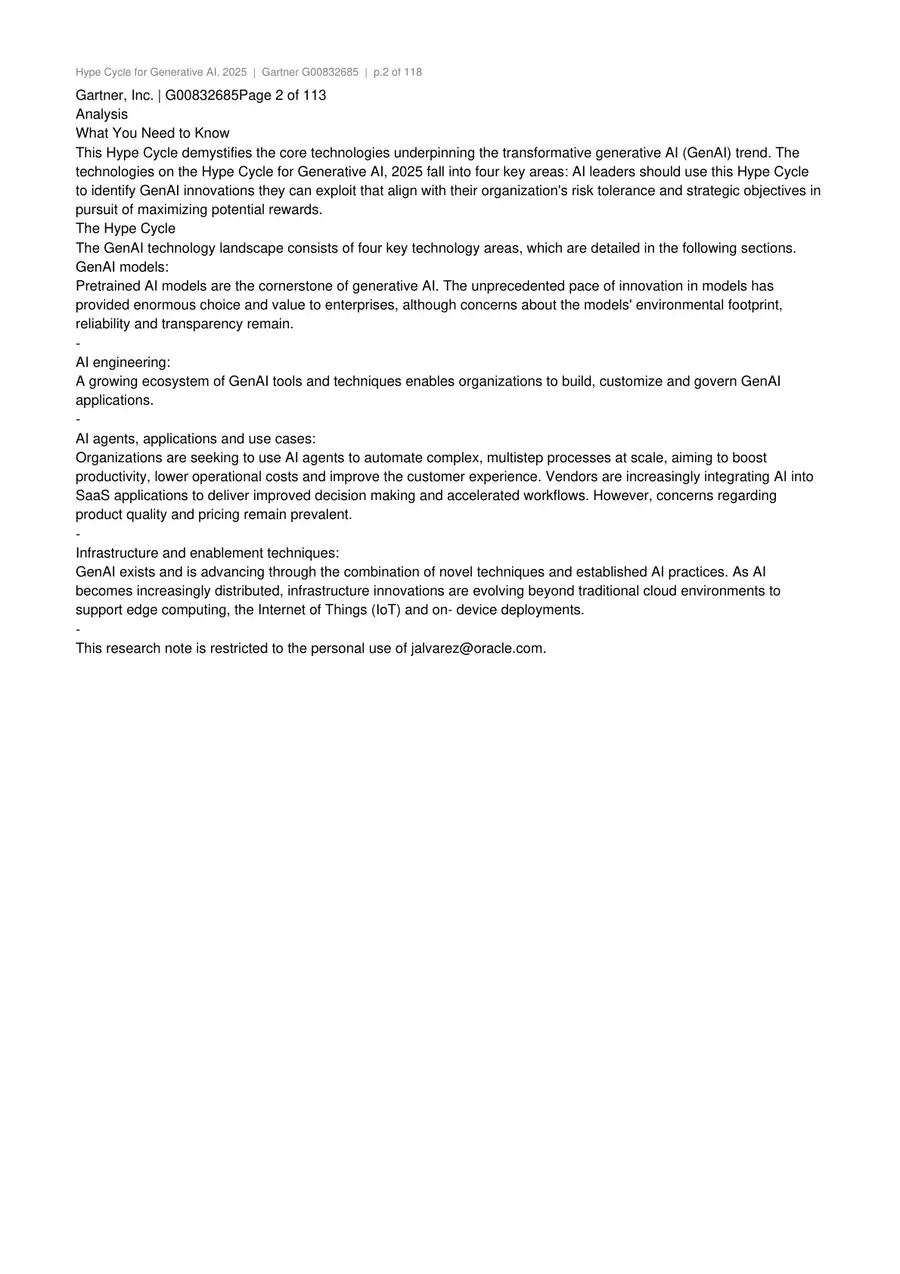
Gartner, Inc. | G00832685Page 2 of 113 Analysis What You Need to Know This Hype Cycle demystifies the core technologies underpinning the transformative generative AI (GenAI) trend. The technologies on the Hype Cycle for Generative AI, 2025 fall into four key areas: AI leaders should use this Hype Cycle to identify GenAI innovations they can exploit that align with their organization's risk tolerance and strategic objectives in pursuit of maximizing potential rewards. The Hype Cycle The GenAI technology landscape consists of four key technology areas, which are detailed in the following sections. GenAI models: Pretrained AI models are the cornerstone of generative AI. The unprecedented pace of innovation in models has provided enormous choice and value to enterprises, although concerns about the models' environmental footprint, reliability and transparency remain. AI engineering: A growing ecosystem of GenAI tools and techniques enables organizations to build, customize and govern GenAI applications. AI agents, applications and use cases: Organizations are seeking to use AI agents to automate complex, multistep processes at scale, aiming to boost productivity, lower operational costs and improve the customer experience. Vendors are increasingly integrating AI into SaaS applications to deliver improved decision making and accelerated workflows. However, concerns regarding product quality and pricing remain prevalent. Infrastructure and enablement techniques: GenAI exists and is advancing through the combination of novel techniques and established AI practices. As AI becomes increasingly distributed, infrastructure innovations are evolving beyond traditional cloud environments to support edge computing, the Internet of Things (IoT) and on- device deployments. This research note is restricted to the personal use of jalvarez@oracle.com.
Hype Cycle for Generative AI, 2025…
Hype Cycle for Generative AI, 2025 | Gartner G00832685 | p.3 of 118
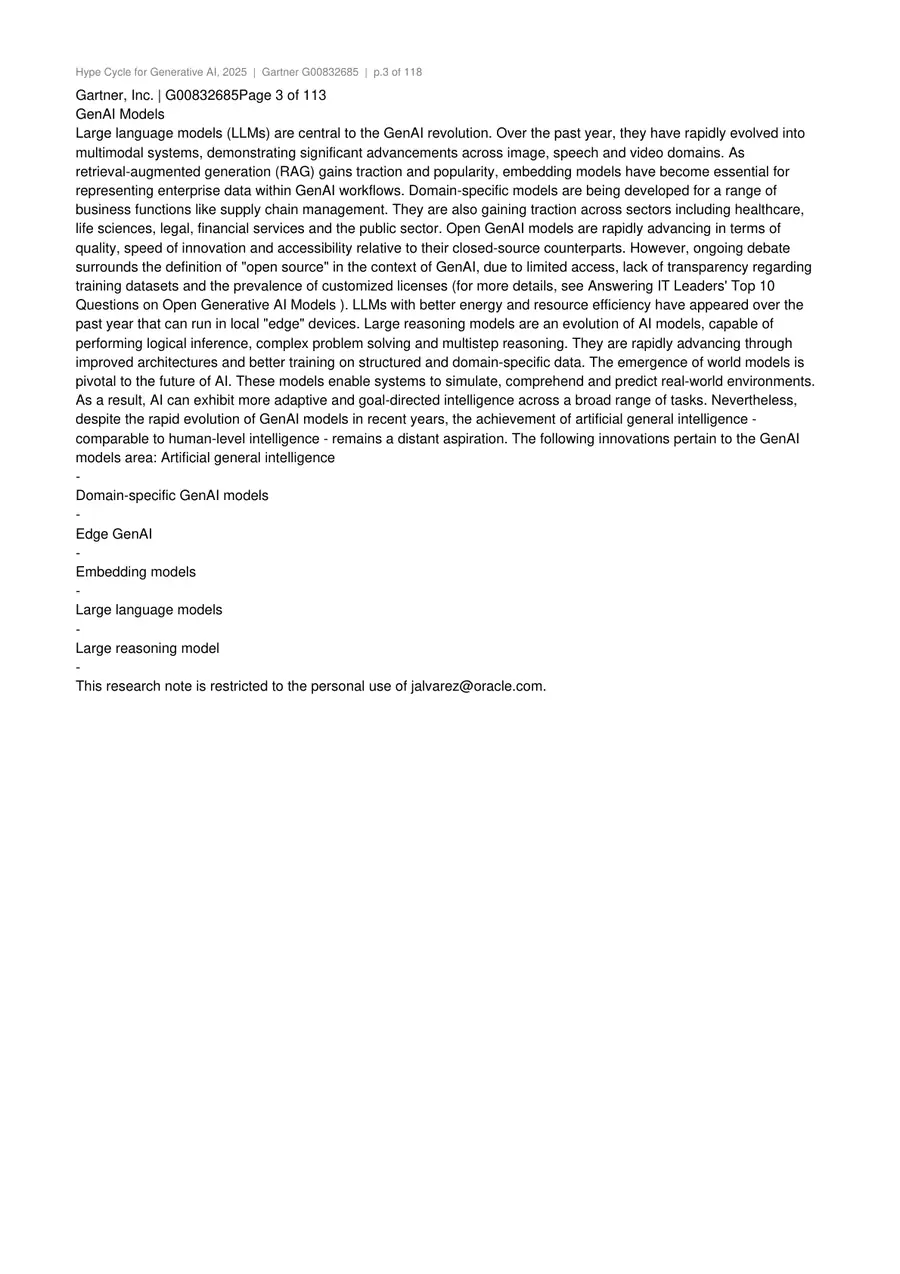
Gartner, Inc. | G00832685Page 3 of 113 GenAI Models Large language models (LLMs) are central to the GenAI revolution. Over the past year, they have rapidly evolved into multimodal systems, demonstrating significant advancements across image, speech and video domains. As retrieval-augmented generation (RAG) gains traction and popularity, embedding models have become essential for representing enterprise data within GenAI workflows. Domain-specific models are being developed for a range of business functions like supply chain management. They are also gaining traction across sectors including healthcare, life sciences, legal, financial services and the public sector. Open GenAI models are rapidly advancing in terms of quality, speed of innovation and accessibility relative to their closed-source counterparts. However, ongoing debate surrounds the definition of "open source" in the context of GenAI, due to limited access, lack of transparency regarding training datasets and the prevalence of customized licenses (for more details, see Answering IT Leaders' Top 10 Questions on Open Generative AI Models ). LLMs with better energy and resource efficiency have appeared over the past year that can run in local "edge" devices. Large reasoning models are an evolution of AI models, capable of performing logical inference, complex problem solving and multistep reasoning. They are rapidly advancing through improved architectures and better training on structured and domain-specific data. The emergence of world models is pivotal to the future of AI. These models enable systems to simulate, comprehend and predict real-world environments. As a result, AI can exhibit more adaptive and goal-directed intelligence across a broad range of tasks. Nevertheless, despite the rapid evolution of GenAI models in recent years, the achievement of artificial general intelligence - comparable to human-level intelligence - remains a distant aspiration. The following innovations pertain to the GenAI models area: Artificial general intelligence Domain-specific GenAI models Edge GenAI Embedding models Large language models Large reasoning model This research note is restricted to the personal use of jalvarez@oracle.com.