AI 研究报告图文讲义4455 字

安永|Global CEO Outlook Survey May 2026

·全库 655 / 711

《安永|Global CEO Outlook Survey May 2026》共 17 页、0.4 万字,通篇围绕 ROI、Attention 展开,归在「AI 研究报告」这一层。

覆盖ROIAttention

适合要拿第三方研究报告做对标、判断自己 AI 转型走到哪一步的人

目录骨架(8 节)
  1. Executive summary
  2. Geopolitics is now a core driver
  3. AI investment is moving from
  4. Regulation and trust are
  5. Employees need time
  6. Capabilities are overtaking scale
  7. Summary
  8. Contents

原 PDF 已逐页还原成图,共 17 页;左侧目录可直接跳页。右侧文字取自原件文字层, 以图为准;点图可全屏放大。

本讲义目录 · 3 页
  1. 01The CEO Imperative Series
  2. 02Executive summary
  3. 03Geopolitics is now a core driver
011 / 3
第 1 页
第 1 页

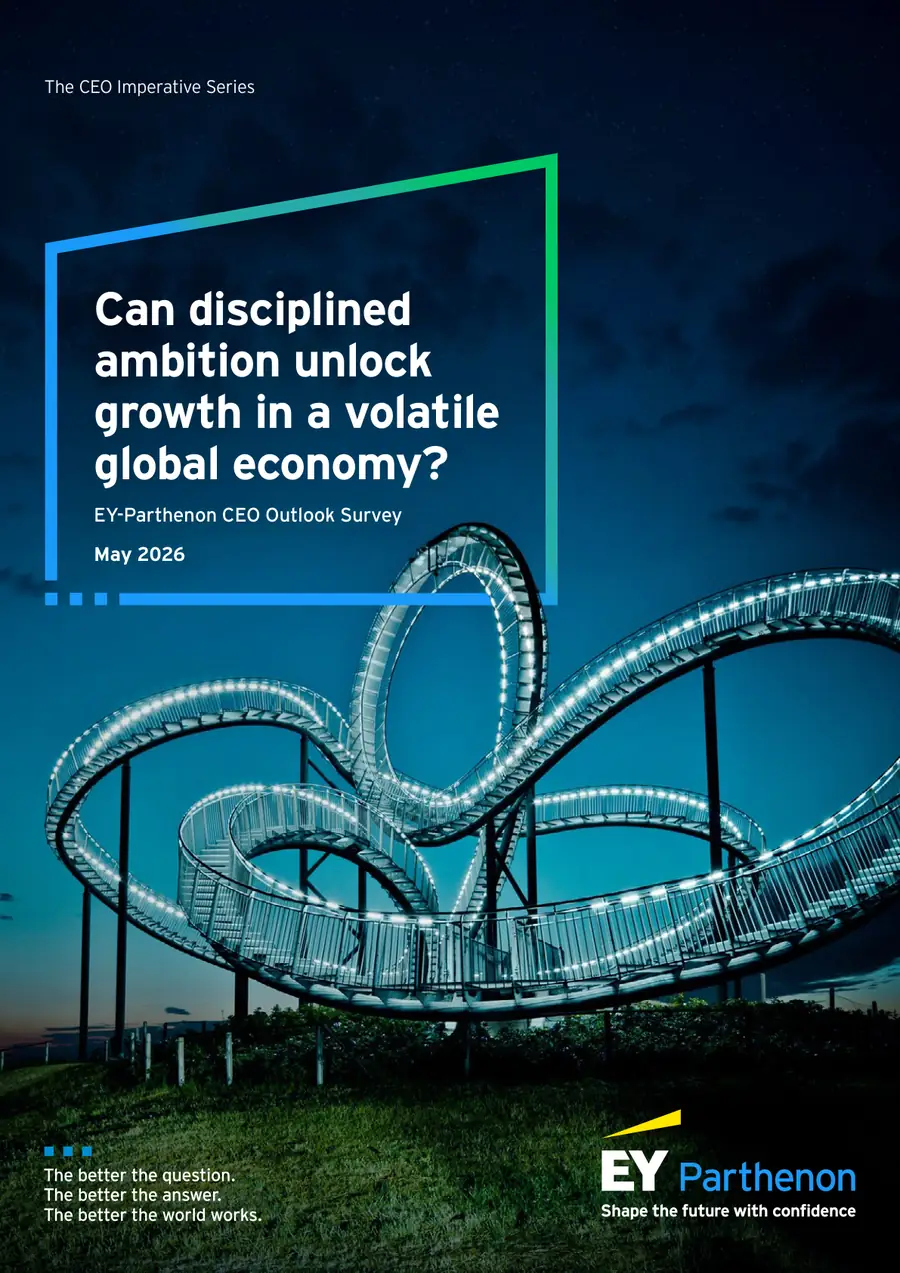
The CEO Imperative Series

The CEO Imperative Series

Can disciplined ambition unlock growth in a volatile global economy?

EY-Parthenon CEO Outlook Survey

022 / 3
第 2 页:Executive summary
第 2 页

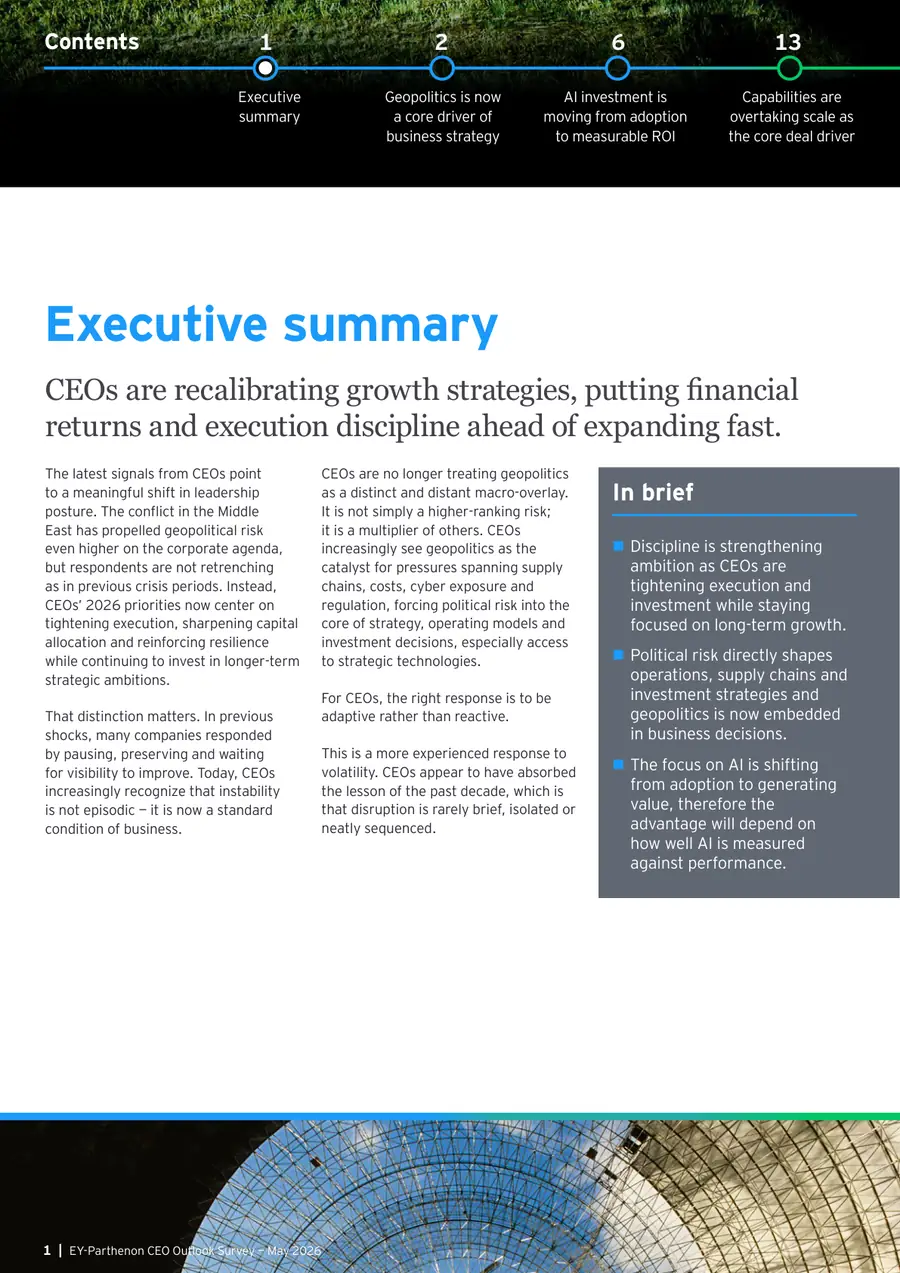
Executive summary

Contents

CEOs are recalibrating growth strategies, putting financial returns and execution discipline ahead of expanding fast.

The latest signals from CEOs point to a meaningful shift in leadership posture. The conflict in the Middle East has propelled geopolitical risk even higher on the corporate agenda, but respondents are not retrenching as in previous crisis periods. Instead, CEOs’ 2026 priorities now center on tightening execution, sharpening capital allocation and reinforcing resilience while continuing to invest in longer-term strategic ambitions. That distinction matters. In previous shocks, many companies responded by pausing, preserving and waiting for visibility to improve. Today, CEOs increasingly recognize that instability is not episodic — it is now a standard condition of business.

1 | EY-Parthenon CEO Outlook Survey — May 2026

Geopolitics is now a core driver of business strategy

CEOs are no longer treating geopolitics as a distinct and distant macro-overlay. It is not simply a higher-ranking risk; it is a multiplier of others. CEOs increasingly see geopolitics as the catalyst for pressures spanning supply chains, costs, cyber exposure and regulation, forcing political risk into the core of strategy, operating models and investment decisions, especially access to strategic technologies. For CEOs, the right response is to be adaptive rather than reactive. This is a more experienced response to volatility. CEOs appear to have absorbed the lesson of the past decade, which is that disruption is rarely brief, isolated or neatly sequenced.

AI investment is moving from adoption to measurable ROI

In brief

„ Discipline is strengthening ambition as CEOs are tightening execution and investment while staying focused on long-term growth. „ Political risk directly shapes operations, supply chains and investment strategies and geopolitics is now embedded in business decisions. „ The focus on AI is shifting from adoption to generating value, therefore the advantage will depend on how well AI is measured against performance.

Capabilities are overtaking scale as the core deal driver

033 / 3
第 3 页:Geopolitics is now a core driver
第 3 页

Geopolitics is now a core driver

of business strategy

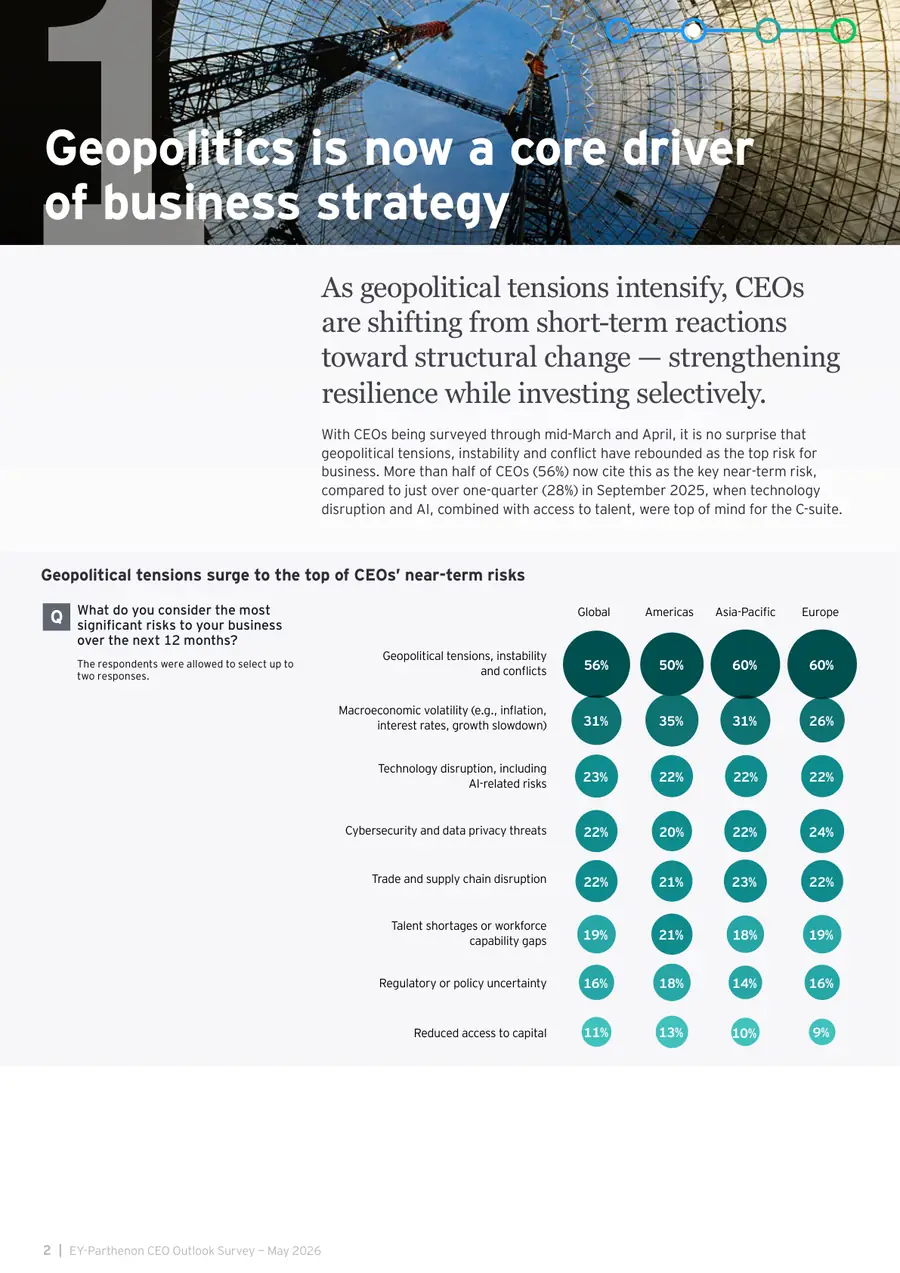
Geopolitical tensions surge to the top of CEOs’ near-term risks What do you consider the most

significant risks to your business over the next 12 months?

The respondents were allowed to select up to two responses.

2 | EY-Parthenon CEO Outlook Survey — May 2026

As geopolitical tensions intensify, CEOs are shifting from short‑term reactions toward structural change — strengthening resilience while investing selectively.

With CEOs being surveyed through mid-March and April, it is no surprise that geopolitical tensions, instability and conflict have rebounded as the top risk for business. More than half of CEOs (56%) now cite this as the key near-term risk, compared to just over one-quarter (28%) in September 2025, when technology disruption and AI, combined with access to talent, were top of mind for the C-suite.

Geopolitical tensions, instability and conflicts Macroeconomic volatility (e.g., inflation, interest rates, growth slowdown)

Technology disruption, including AI-related risks

Cybersecurity and data privacy threats

Trade and supply chain disruption

Talent shortages or workforce capability gaps

Regulatory or policy uncertainty

Reduced access to capital

Global Americas Asia-Pacific Europe

56% 50% 60% 60%

31% 35% 31% 26%

23% 22% 22% 22%

22% 20% 22% 24%

22% 21% 23% 22%

19% 21% 18% 19%

16% 18% 14% 16%

11% 13% 9% 10%

资料里没有你的场景?

把你手上的数据和想解决的那个环节发上来,我们按具体情况回,不复述方法论。

发布需求