AI 研究报告图文讲义5214 字

安永|Global CEO Outlook Survey October 2026

·全库 656 / 711

《安永|Global CEO Outlook Survey October 2026》共 17 页、0.5 万字,通篇围绕 ROI、Attention、embedding 展开,归在「AI 研究报告」这一层。

覆盖ROIAttentionembedding

适合要拿第三方研究报告做对标、判断自己 AI 转型走到哪一步的人

目录骨架(8 节)
  1. Executive summary
  2. The levers CEOs pull will
  3. We require every project
  4. AI economics and the
  5. Will AI change the work before it changes
  6. Growth is becoming a
  7. Where AI creates impact will
  8. Summary

原 PDF 已逐页还原成图,共 17 页;左侧目录可直接跳页。右侧文字取自原件文字层, 以图为准;点图可全屏放大。

本讲义目录 · 3 页
  1. 01The CEO Imperative Series
  2. 02Executive summary
  3. 03The levers CEOs pull will
011 / 3
第 1 页
第 1 页

The CEO Imperative Series

The CEO Imperative Series

How can CEOs turn AI productivity gains into lasting value?

EY-Parthenon CEO Outlook Survey October 2026

022 / 3
第 2 页:Executive summary
第 2 页

Executive summary

Contents

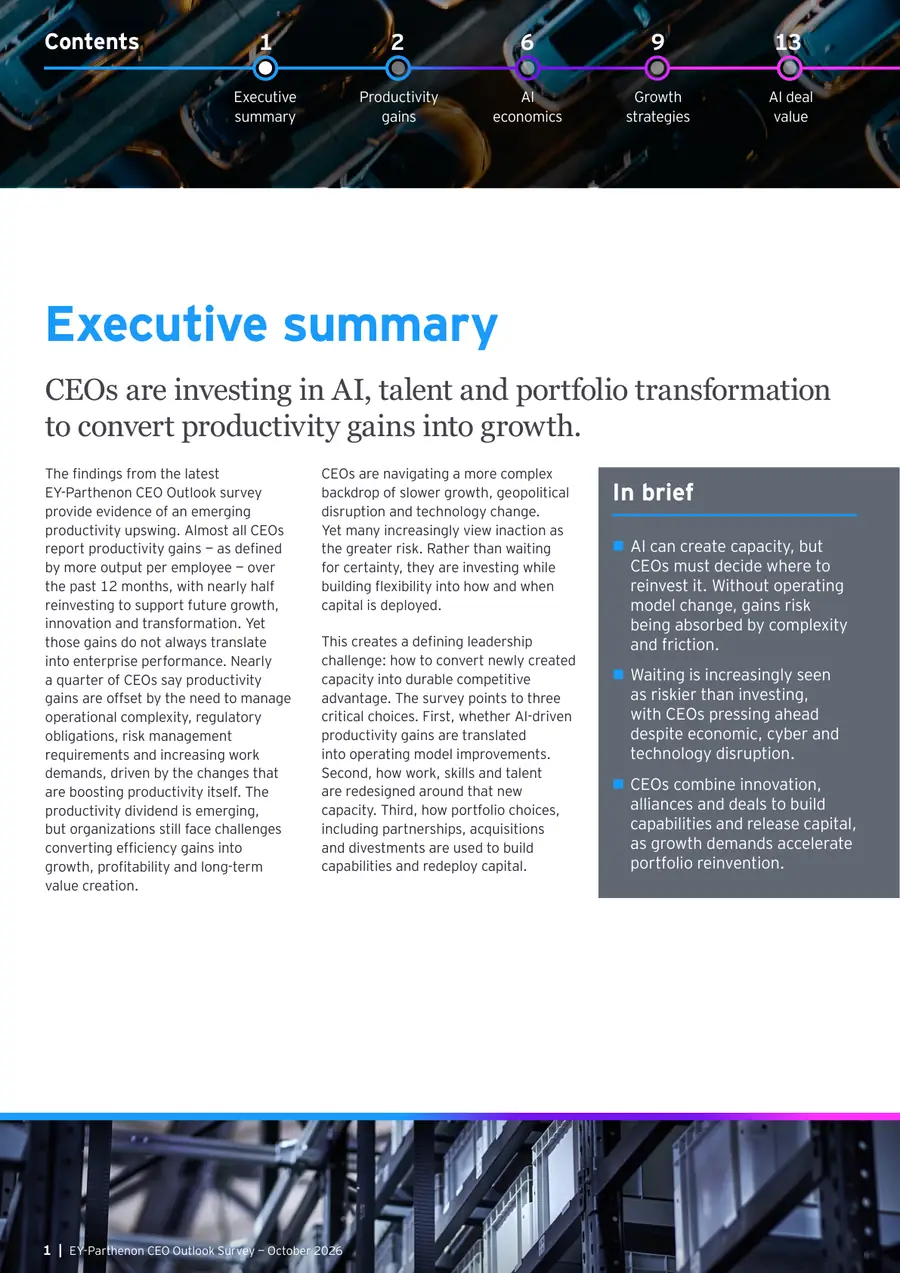
CEOs are investing in AI, talent and portfolio transformation to convert productivity gains into growth.

The findings from the latest EY‑Parthenon CEO Outlook survey provide evidence of an emerging productivity upswing. Almost all CEOs report productivity gains — as defined by more output per employee — over the past 12 months, with nearly half reinvesting to support future growth, innovation and transformation. Yet those gains do not always translate into enterprise performance. Nearly a quarter of CEOs say productivity gains are offset by the need to manage operational complexity, regulatory obligations, risk management requirements and increasing work demands, driven by the changes that are boosting productivity itself. The productivity dividend is emerging, but organizations still face challenges converting efficiency gains into growth, profitability and long-term value creation.

1 | EY-Parthenon CEO Outlook Survey — October 2026

Productivity gains

CEOs are navigating a more complex backdrop of slower growth, geopolitical disruption and technology change. Yet many increasingly view inaction as the greater risk. Rather than waiting for certainty, they are investing while building flexibility into how and when capital is deployed. This creates a defining leadership challenge: how to convert newly created capacity into durable competitive advantage. The survey points to three critical choices. First, whether AI‑driven productivity gains are translated into operating model improvements. Second, how work, skills and talent are redesigned around that new capacity. Third, how portfolio choices, including partnerships, acquisitions and divestments are used to build capabilities and redeploy capital.

AI economics

Growth strategies

In brief

„ AI can create capacity, but CEOs must decide where to reinvest it. Without operating model change, gains risk being absorbed by complexity and friction. „ Waiting is increasingly seen as riskier than investing, with CEOs pressing ahead despite economic, cyber and technology disruption. „ CEOs combine innovation, alliances and deals to build capabilities and release capital, as growth demands accelerate portfolio reinvention.

AI deal value

033 / 3
第 3 页:The levers CEOs pull will
第 3 页

The levers CEOs pull will

determine whether productivity creates value

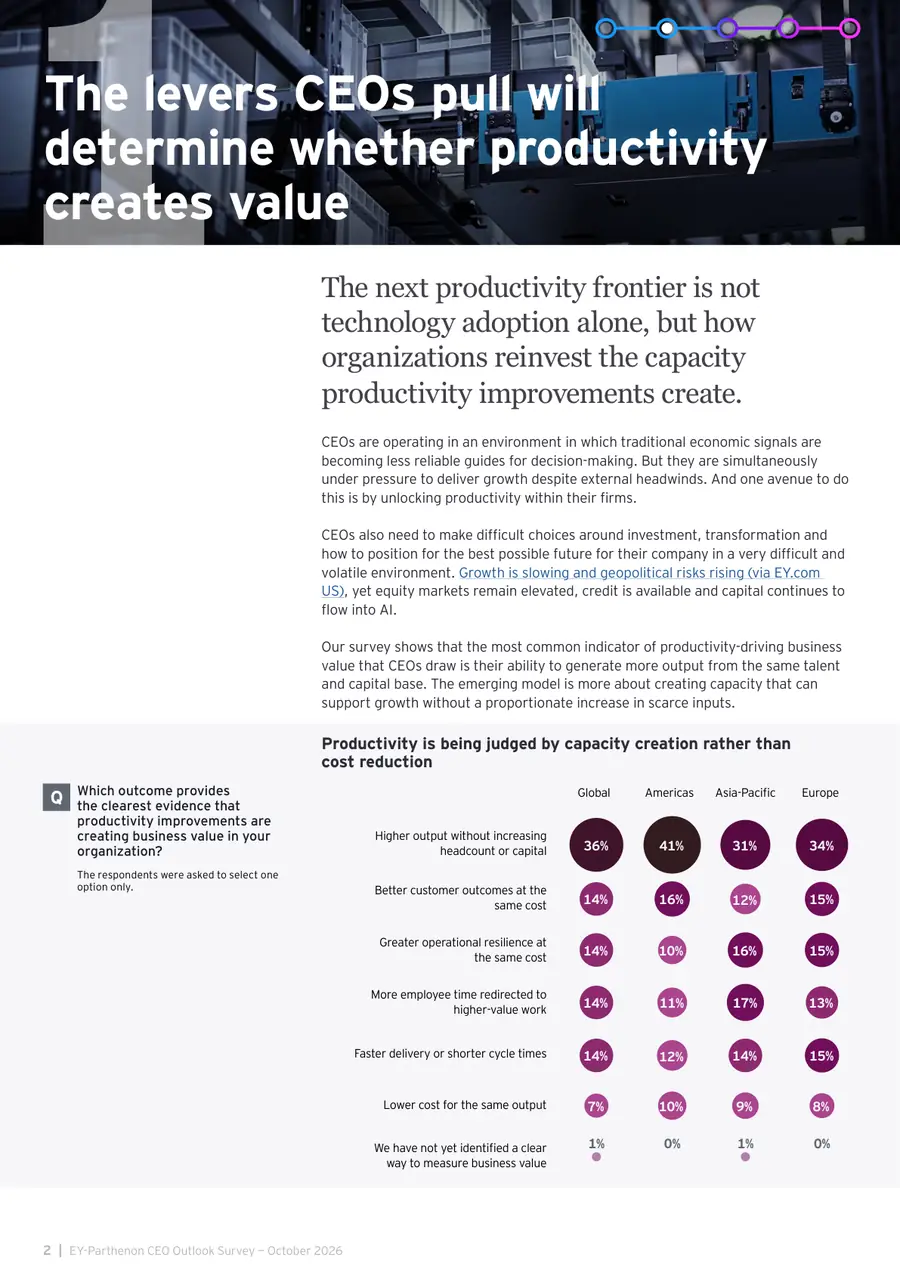
Which outcome provides

the clearest evidence that productivity improvements are creating business value in your organization?

The respondents were asked to select one option only.

2 | EY-Parthenon CEO Outlook Survey — October 2026

The next productivity frontier is not technology adoption alone, but how organizations reinvest the capacity productivity improvements create.

CEOs are operating in an environment in which traditional economic signals are becoming less reliable guides for decision-making. But they are simultaneously under pressure to deliver growth despite external headwinds. And one avenue to do this is by unlocking productivity within their firms. CEOs also need to make difficult choices around investment, transformation and how to position for the best possible future for their company in a very difficult and volatile environment. Growth is slowing and geopolitical risks rising (via EY.com US), yet equity markets remain elevated, credit is available and capital continues to flow into AI. Our survey shows that the most common indicator of productivity-driving business value that CEOs draw is their ability to generate more output from the same talent and capital base. The emerging model is more about creating capacity that can support growth without a proportionate increase in scarce inputs. Productivity is being judged by capacity creation rather than cost reduction

Higher output without increasing headcount or capital Better customer outcomes at the same cost Greater operational resilience at the same cost More employee time redirected to higher‑value work

Faster delivery or shorter cycle times

Lower cost for the same output

We have not yet identified a clear way to measure business value

Global Americas Asia-Pacific Europe

36% 41% 31% 34%

14% 16% 15% 12%

14% 16% 15% 10%

11% 14% 17% 13%

14% 14% 15% 12%

7% 9% 8% 10% 1% 0% 1% 0%

资料里没有你的场景?

把你手上的数据和想解决的那个环节发上来,我们按具体情况回,不复述方法论。

发布需求