AI 研究报告图文讲义5548 字

Forrester|The Forrester Wave Conversational AI Platforms For Employee Services Q3 2026

·全库 708 / 711

《Forrester|The Forrester Wave Conversational AI Platforms For Employee Services Q3 2026》共 18 页、0.6 万字,通篇围绕 Agent、embedding 展开,归在「AI 研究报告」这一层。

覆盖Agentembedding

适合要拿第三方研究报告做对标、判断自己 AI 转型走到哪一步的人

目录骨架(8 节)
  1. The Forrester Wave™: Conversational AI
  2. HCLSonware
  3. Leaders
  4. Strong Performers
  5. Evaluation Overview
  6. Source & Copyright
  7. Summary
  8. Evaluation Summary

原 PDF 已逐页还原成图,共 18 页;左侧目录可直接跳页。右侧文字取自原件文字层, 以图为准;点图可全屏放大。

本讲义目录 · 3 页
  1. 01The Forrester Wave™: Conversational AI
  2. 02initial use cases faster.
  3. 03FIGURE
011 / 3
第 1 页:The Forrester Wave™: Conversational AI
第 1 页

The Forrester Wave™: Conversational AI

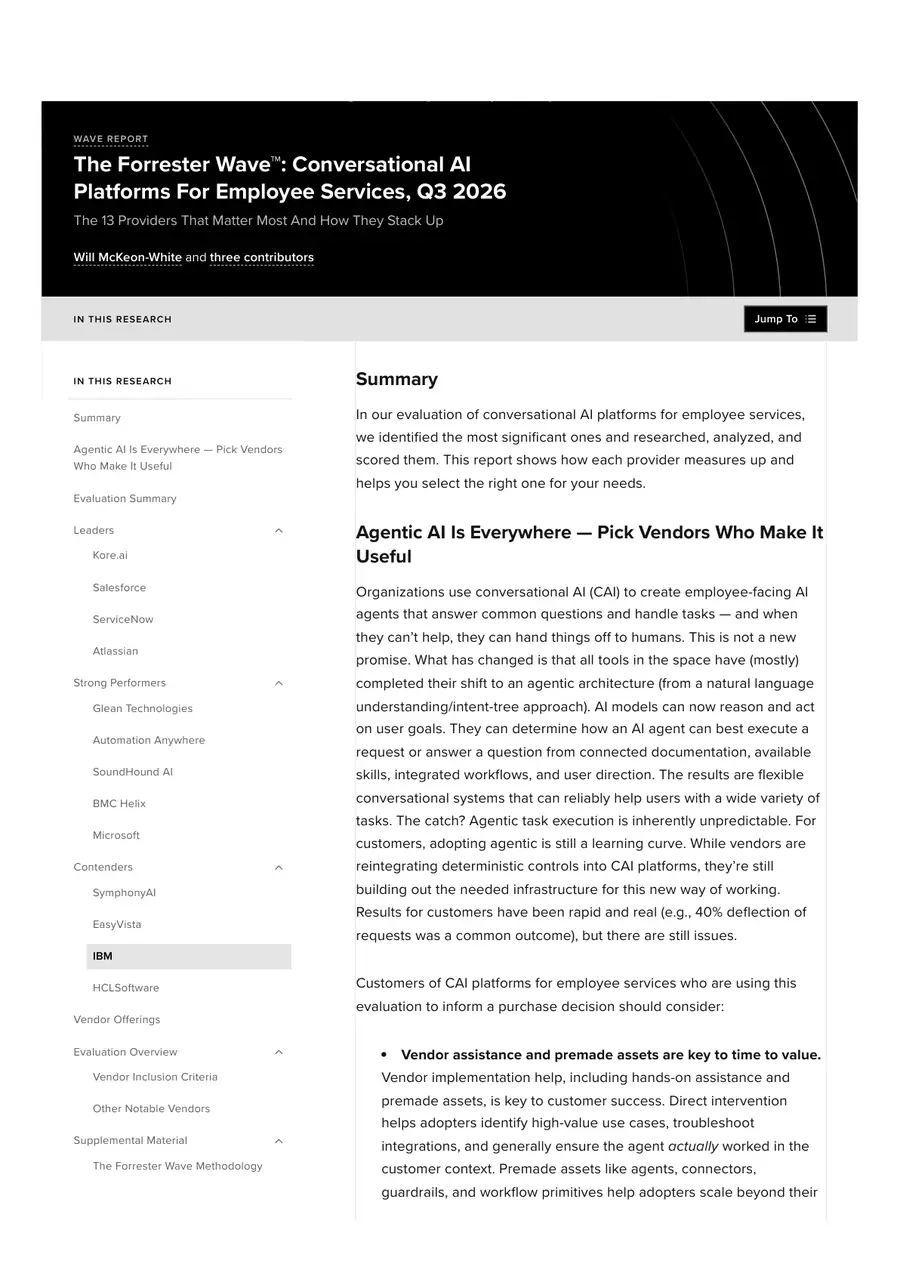
WAVE REPORT

Platforms For Employee Services, Q3 2026

The 13 Providers That Matter Most And How They Stack Up Will McKeon-White

IN THIS RESEARCH

IN THIS RESEARCH Summary Agentic AI Is Everywhere — Pick Vendors Who Make It Useful Evaluation Summary Leaders Kore.ai Salesforce ServiceNow Atlassian Strong Performers Glean Technologies Automation Anywhere SoundHound AI BMC Helix Microsoft Contenders SymphonyAI EasyVista IBM HCLSoftware Vendor Offerings Evaluation Overview Vendor Inclusion Criteria Other Notable Vendors Supplemental Material The Forrester Wave Methodology

three contributors and

Jump To

Summary

In our evaluation of conversational AI platforms for employee services, we identified the most significant ones and researched, analyzed, and scored them. This report shows how each provider measures up and helps you select the right one for your needs.

Agentic AI Is Everywhere — Pick Vendors Who Make It Useful

Organizations use conversational AI (CAI) to create employee-facing AI agents that answer common questions and handle tasks — and when they can’t help, they can hand things off to humans. This is not a new promise. What has changed is that all tools in the space have (mostly) completed their shift to an agentic architecture (from a natural language understanding/intent-tree approach). AI models can now reason and act on user goals. They can determine how an AI agent can best execute a request or answer a question from connected documentation, available skills, integrated workflows, and user direction. The results are flexible conversational systems that can reliably help users with a wide variety of tasks. The catch? Agentic task execution is inherently unpredictable. For customers, adopting agentic is still a learning curve. While vendors are reintegrating deterministic controls into CAI platforms, they’re still building out the needed infrastructure for this new way of working. Results for customers have been rapid and real (e.g., 40% deflection of requests was a common outcome), but there are still issues.

Customers of CAI platforms for employee services who are using this evaluation to inform a purchase decision should consider:

Vendor assistance and premade assets are key to time to value. Vendor implementation help, including hands-on assistance and premade assets, is key to customer success. Direct intervention helps adopters identify high-value use cases, troubleshoot integrations, and generally ensure the agent actually worked in the customer context. Premade assets like agents, connectors, guardrails, and workflow primitives help adopters scale beyond their

022 / 3
第 2 页
第 2 页

initial use cases faster.

initial use cases faster. Prospects should scrutinize providers’ customer success motion and how they guarantee customers will see value from their platform. Testing the tools isn’t enough. The context layer (and its breadth) determines usefulness to users. Customer knowledge and documentation are rarely centralized or well managed. They’re often distributed through SharePoint, multiple knowledge management platforms, and informal repositories like chat platforms. To be effective amid this complexity, vendors need the ability to integrate all these sources and contextualize them. Context systems like knowledge graphs act as key translation layers for the agent, annotating and connecting knowledge. Adopters should know that these knowledge connectors and context layers ultimately determine agent effectiveness. Development interfaces and agentic controls are still rudimentary. AI agents are new, and adopters should be aware of the basic features missing from builder platforms. Some lack PII redaction; some lack version control. Few agent builders suggest existing agents, skills, or knowledge (e.g., agent, tool, and knowledge awareness). Unhelpfully, all platforms lacked proactive agentic optimization analytics (e.g., a plan that is missing key information, an agent that will break a plan). Another gap: Vendors lacked support for multiplayer development, hampering the ability of multiple contributors to build agents simultaneously.

Evaluation Summary

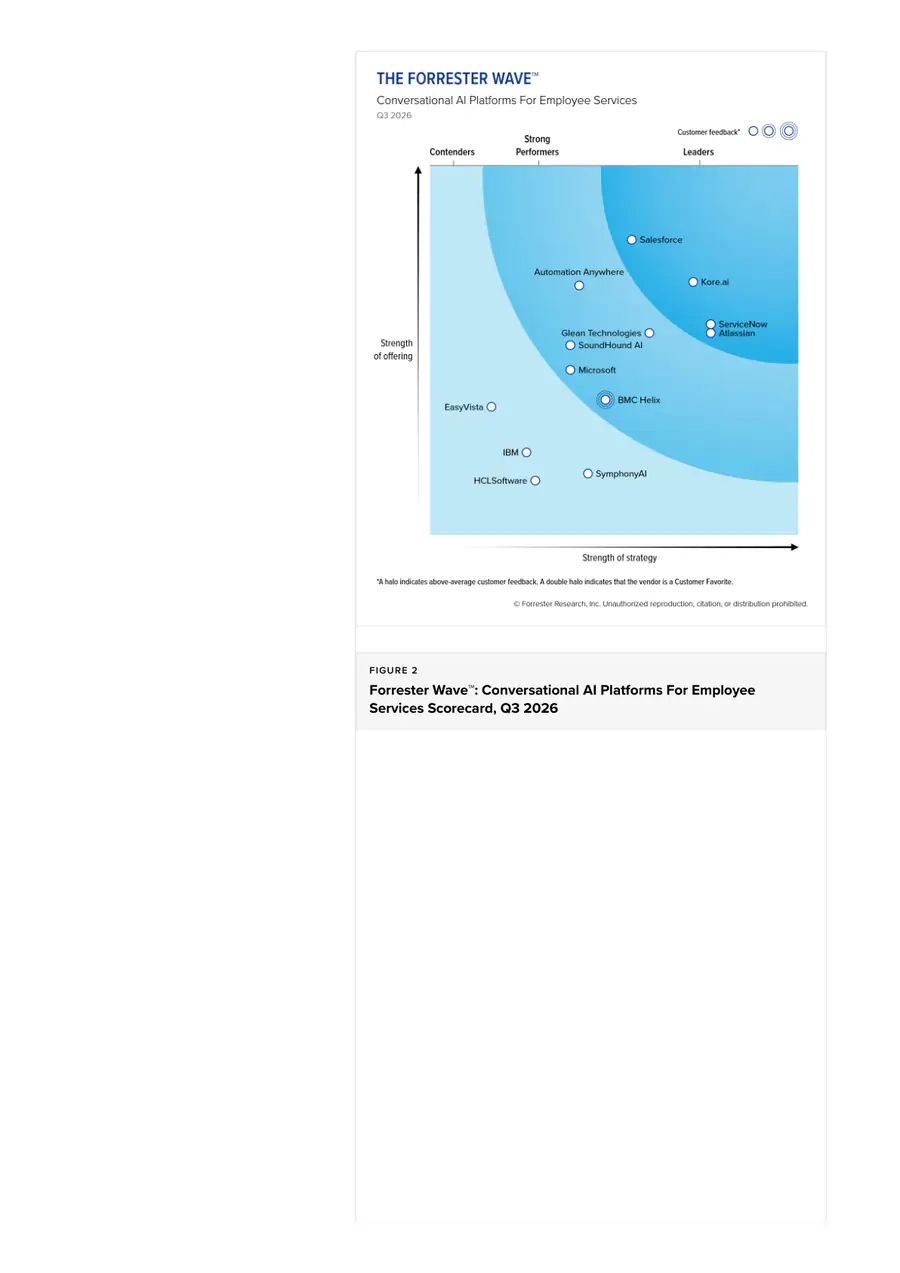
The Forrester Wave™ evaluation highlights Leaders, Strong Performers, and Contenders (see Figures 1 and 2). We intend this evaluation to be a starting point only and encourage clients to view product evaluations and adapt the findings based on their priorities using Forrester’s interactive provider comparison experience.

FIGURE

Forrester Wave™: Conversational AI Platforms For Employee Services, Q3 2026

Integrity Policy

033 / 3
第 3 页
第 3 页

FIGURE

FIGURE

Forrester Wave™: Conversational AI Platforms For Employee Services Scorecard, Q3 2026

资料里没有你的场景?

把你手上的数据和想解决的那个环节发上来,我们按具体情况回,不复述方法论。

发布需求