
Forrester|The State Of AI 2025
《Forrester|The State Of AI 2025》共 13 页、0.3 万字,通篇围绕 ROI、Attention 展开,归在「AI 研究报告」这一层。
适合要拿第三方研究报告做对标、判断自己 AI 转型走到哪一步的人
目录骨架(4 节)
- The State Of AI, 2025
- Source & Copyright
- Summary
- Remain Elusive
原 PDF 已逐页还原成图,共 13 页;左侧目录可直接跳页。右侧文字取自原件文字层, 以图为准;点图可全屏放大。
本讲义目录 · 3 页
The State Of AI, 2025
DATA OVERVIEW REPORT
A First Look At The Data From Forrester’s State Of AI Survey, 2025 Brian Hopkins, Zachary Stone,
IN THIS RESEARCH
IN THIS RESEARCH Summary Firms Are Accelerating AI Deployment But Missing The Real Potential AI Leadership Roles Are Becoming Clear — But Misalignments Are The Norm Business And Tech Leadership Are Divided Leaders Inspire With Vision But Falter On Delivery Firms Focus On Output But Overlook Workforce Readiness AI Adoption Outpaces Governance Firms Fear AI Risk But Fail To Govern It AI Benefits Are Real, But Earnings And Innovation Remain Elusive Short-Term ROI Expectations Limit Strategic Value Firms Struggle To Link AI To Financial Outcomes AI Reaches More Workers But Impacts Vary Widely
and three contributors
Jump To
Summary
Organizations are rapidly deploying AI across functions, but most lack the strategic clarity, leadership alignment, workforce enablement, and governance needed to realize its full value. Forrester’s State Of AI Survey, 2025 reveals that while over 70% of respondents’ firms have generative or predictive AI in production, few are measuring its financial impact or investing for long-term transformation. Technology leaders dominate AI strategy, but business leaders remain fragmented, and workforces are becoming disillusioned. This report will help you understand the current state of AI adoption, identify critical gaps in strategy and governance, and recalibrate your approach to unlock the value your leadership expects.
Firms Are Accelerating AI Deployment But Missing The Real Potential
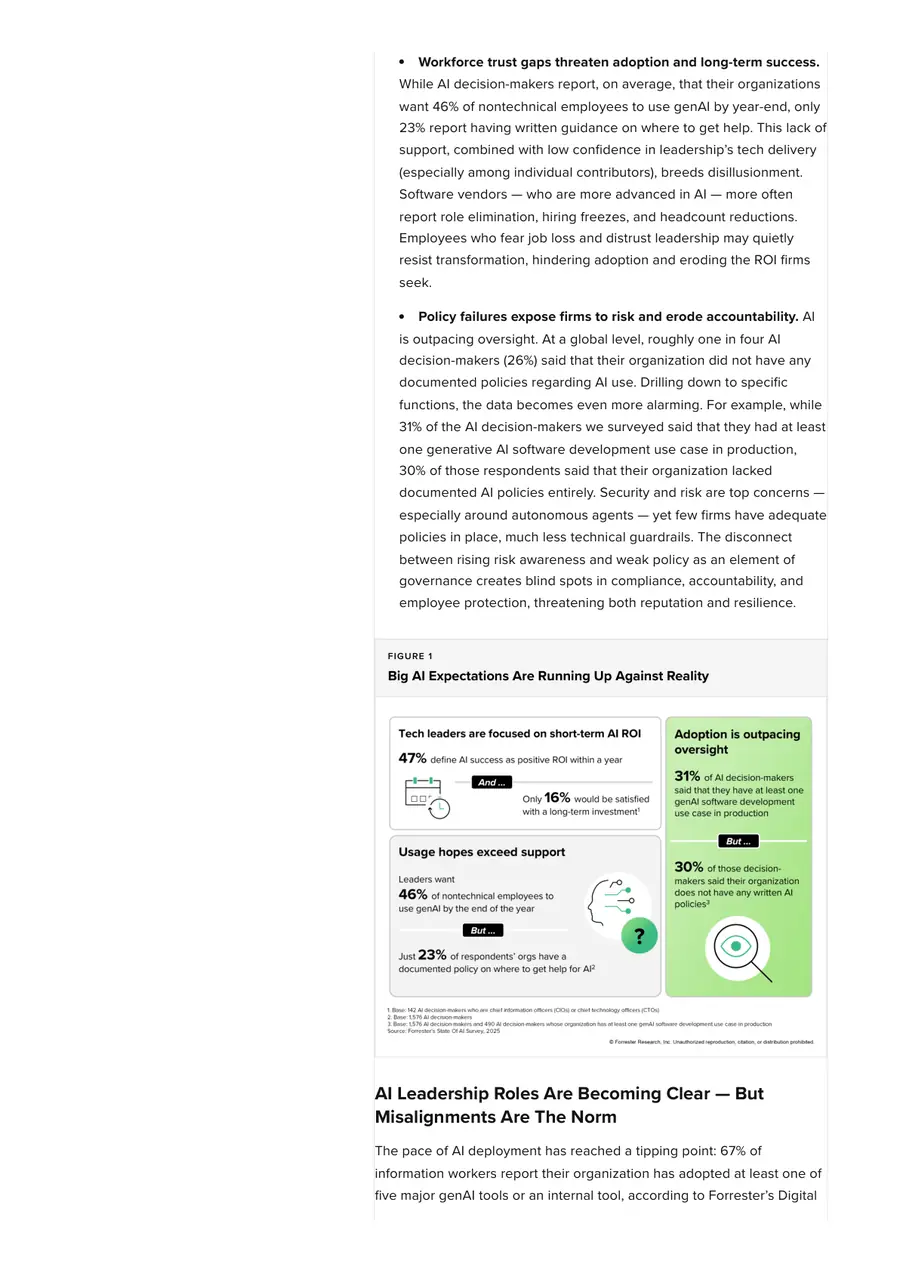
Forrester’s State Of AI Survey, 2025 reveals a surge in AI deployment across organizations: 78% of AI decision-makers report their organization already has generative or predictive AI in production. Yet this momentum masks deeper strategic gaps. Technology leaders are focused on short- term ROI, usage expectations exceed support, and adoption is outpacing governance (see Figure 1). These issues compound to stall the true potential of AI as a transformative force that will demand business reinvention:
IT-led deployments prioritize rapid productivity but stall broader transformation. Technology organizations lead AI efforts, with IT operations and data analytics as top use cases. This cost-center focus yields measurable efficiency gains but rarely translates to growth or EBITDA impact. Tech leaders (CIOs and CTOs) prioritize short-term ROI, with almost half (47%) reporting they’d need to see a positive ROI within a year to consider their investments successful. This is not realistic as AI value at scale requires foundational investments in data and governance that take time. Furthermore, without a longer horizon point of view, AI will remain a departmental tool focused on business-as-usual efficiency, not a strategic lever — undermining its potential to reinvent value chains or drive innovation across the enterprise.
Workforce trust gaps threaten adoption and long-term success.
Workforce trust gaps threaten adoption and long-term success. While AI decision-makers report, on average, that their organizations want 46% of nontechnical employees to use genAI by year-end, only 23% report having written guidance on where to get help. This lack of support, combined with low confidence in leadership’s tech delivery (especially among individual contributors), breeds disillusionment. Software vendors — who are more advanced in AI — more often report role elimination, hiring freezes, and headcount reductions. Employees who fear job loss and distrust leadership may quietly resist transformation, hindering adoption and eroding the ROI firms seek. Policy failures expose firms to risk and erode accountability. AI is outpacing oversight. At a global level, roughly one in four AI decision-makers (26%) said that their organization did not have any documented policies regarding AI use. Drilling down to specific functions, the data becomes even more alarming. For example, while 31% of the AI decision-makers we surveyed said that they had at least one generative AI software development use case in production, 30% of those respondents said that their organization lacked documented AI policies entirely. Security and risk are top concerns — especially around autonomous agents — yet few firms have adequate policies in place, much less technical guardrails. The disconnect between rising risk awareness and weak policy as an element of governance creates blind spots in compliance, accountability, and employee protection, threatening both reputation and resilience.
Big AI Expectations Are Running Up Against Reality
AI Leadership Roles Are Becoming Clear — But Misalignments Are The Norm
The pace of AI deployment has reached a tipping point: 67% of information workers report their organization has adopted at least one of five major genAI tools or an internal tool, according to Forrester’s Digital
Workplace And Employee Technology Survey, 2025.
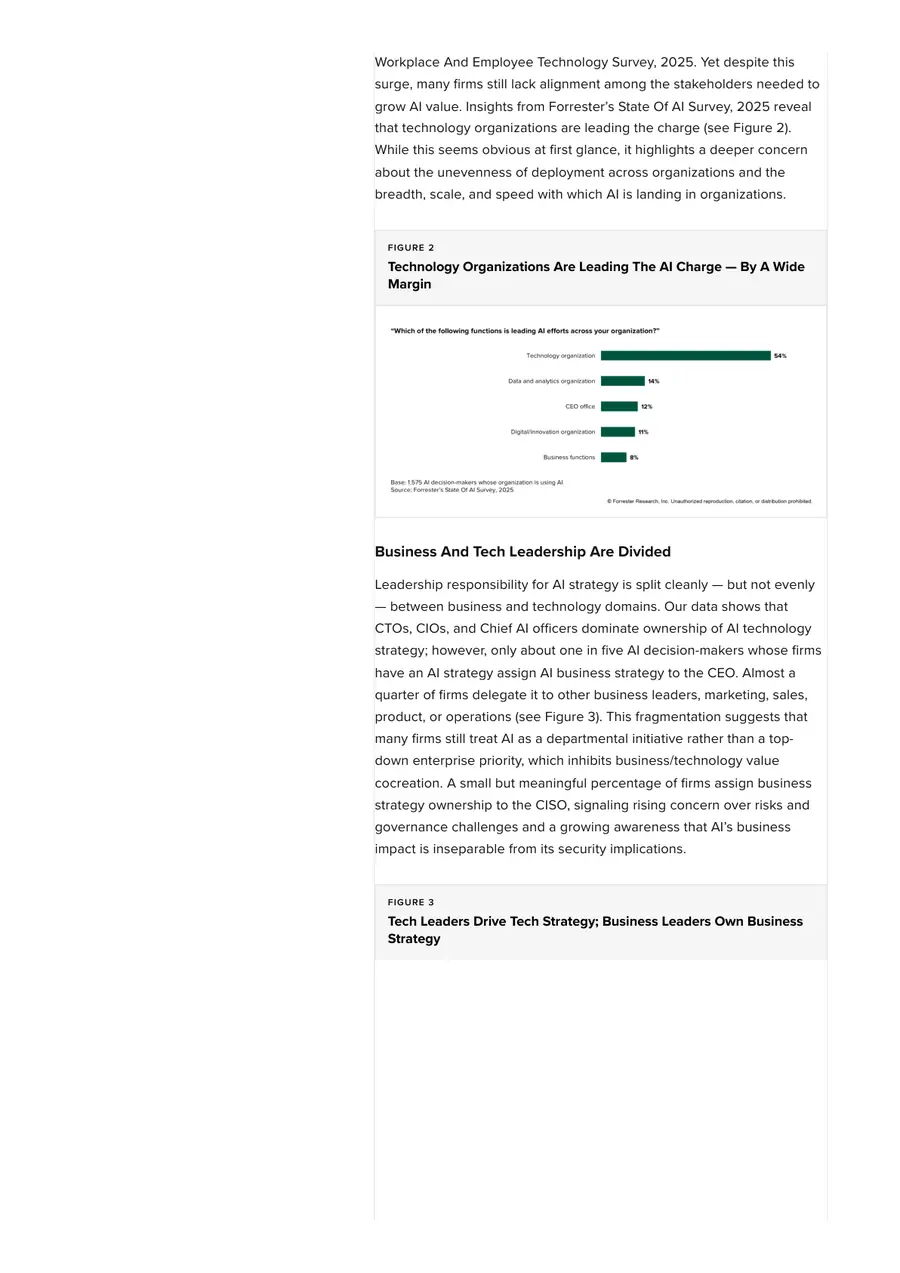
Workplace And Employee Technology Survey, 2025. Yet despite this surge, many firms still lack alignment among the stakeholders needed to grow AI value. Insights from Forrester’s State Of AI Survey, 2025 reveal that technology organizations are leading the charge (see Figure 2). While this seems obvious at first glance, it highlights a deeper concern about the unevenness of deployment across organizations and the breadth, scale, and speed with which AI is landing in organizations.
Technology Organizations Are Leading The AI Charge — By A Wide Margin
Business And Tech Leadership Are Divided Leadership responsibility for AI strategy is split cleanly — but not evenly — between business and technology domains. Our data shows that CTOs, CIOs, and Chief AI officers dominate ownership of AI technology strategy; however, only about one in five AI decision-makers whose firms have an AI strategy assign AI business strategy to the CEO. Almost a quarter of firms delegate it to other business leaders, marketing, sales, product, or operations (see Figure 3). This fragmentation suggests that many firms still treat AI as a departmental initiative rather than a top- down enterprise priority, which inhibits business/technology value cocreation. A small but meaningful percentage of firms assign business strategy ownership to the CISO, signaling rising concern over risks and governance challenges and a growing awareness that AI’s business impact is inseparable from its security implications.
Tech Leaders Drive Tech Strategy; Business Leaders Own Business Strategy